AI for Ownerspowered by Fail Coach
Construction12 min read
Construction Contract Template: 5 Clauses Every Builder Needs
This construction contract template covers 5 essential clauses that protect builders from scope disputes, payment problems, and liability.
By Miha Matlievski|
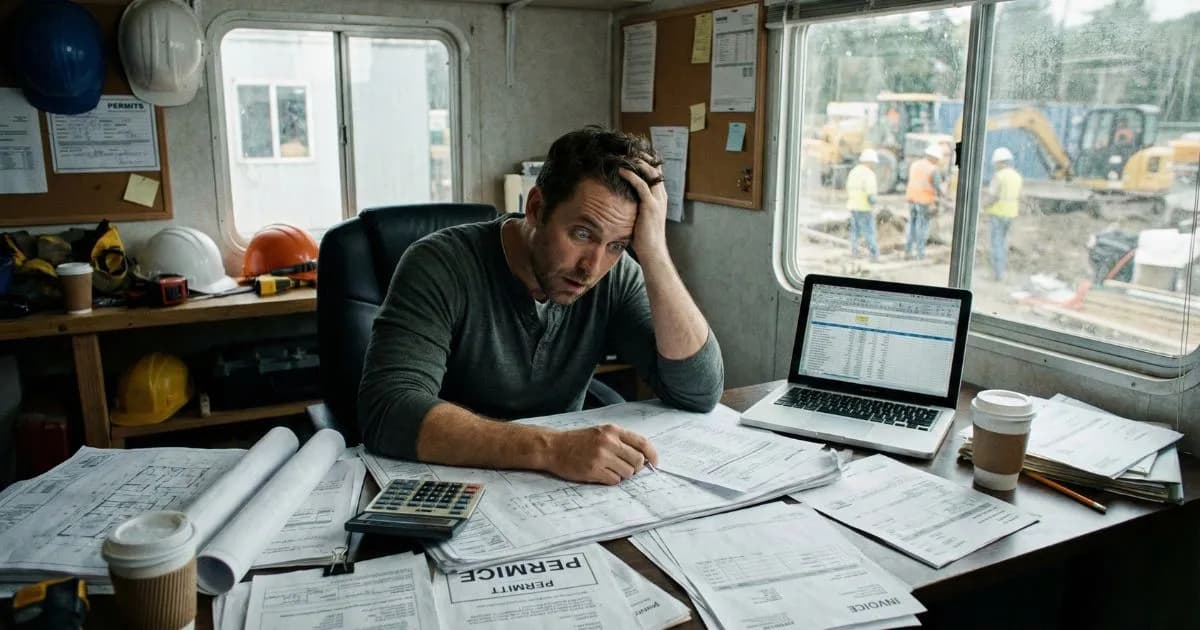
You finished the Johnson kitchen remodel three weeks ago. The client loved it. Shook your hand, said they'd refer you to everyone they know. Then the final invoice hit their inbox, and suddenly they "don't remember" agreeing to the upgraded backsplash, the extra outlet behind the island, or the cabinet hardware swap. Now you're staring at a $4,200 dispute and a construction contract template that says almost nothing about any of it.
This happens to builders constantly. And it's almost never about bad clients or bad work. It's about bad contracts.
The Real Cost of Weak Contract Clauses
Here's the thing most builders don't calculate: the cost of a contract dispute isn't just the disputed amount. It's the time you spend going back and forth over emails and texts. It's the two weeks where you can't focus on the next job because you're dealing with this mess. It's the review they leave online when things go sideways.
A significant share of construction projects experience major changes during execution. When those changes aren't documented properly, they become disputes. And disputes become write-offs.
If you're running even a modest operation doing $500K to $1M a year, losing just 2-3% to undocumented changes and weak contract language means $10,000 to $30,000 walking out the door annually. That's not a rounding error. That's a truck payment, a helper's salary, or your family vacation.
The real kicker? Most of these losses are completely preventable. Not with a lawyer on retainer. Not with expensive software. With five construction contract clauses that belong in every agreement you sign.
Why Generic Construction Contract Templates Leave You Exposed
Most builders I talk to fall into one of two camps. Either they're using a template they downloaded years ago and never updated, or they're working off proposals that read more like estimates than binding agreements.
The problem with generic contracts is they're built to cover everything in broad strokes and nothing in detail. They'll say "contractor will perform work as described in the attached scope" but won't define what happens when the client changes that scope mid-project. They'll mention "payment due upon completion" but won't define what "completion" actually means.
And then there's the handshake crowd. I get it. You've been building for 15 years, you know your clients, your word is your bond. But the client who's your best friend during the design phase can turn into someone you don't recognize when the final bill arrives. It's not personal. It's human nature. People's memories get fuzzy when money's on the table.
The root cause is that most builders are craftsmen first and business owners second. You got into this trade because you're good with your hands, not because you love contract law. So the paperwork gets the least attention, even though it's the thing that protects everything else you do.
If you've been dealing with profit fade on your projects, weak contracts are probably one of the biggest contributors.
What You Can Do This Week: The 5 Builder Contract Essentials That Protect Your Business
You don't need a 40-page legal document. You need a clear, specific construction contract template with these five clauses written in plain language. Here's what each one should cover and how to write it.
Clause 1: Scope of Work with Exclusions
This is the foundation of your entire contract, and it's where most builders cut corners. A good scope clause doesn't just say what you WILL do. It says what you WON'T do.
What to include:
- Specific description of all work to be performed
- Materials to be used (brand, grade, color where applicable)
- What's explicitly excluded (landscaping repair, permit fees, appliance installation, whatever isn't your job)
- Reference to specific plans or drawings, dated and version-numbered
- Allowance amounts for any selections not yet finalized
The exclusions matter just as much as the inclusions. When a client says "I assumed you'd fix the drywall damage from the plumbing rough-in," your exclusion list is what settles that conversation in 30 seconds instead of 30 days.
Write it like this: "Contractor will perform the following work as described in plans dated [DATE], version [NUMBER]. Work NOT included in this contract: [list specific items]. Any work not explicitly listed in this scope requires a written change order."
Clause 2: Change Order Process
This is the clause that stops the bleeding. Undocumented verbal agreements on changes are among the most common sources of payment disputes in residential construction. "Can you move that outlet?" "Sure." Three months later, that "sure" costs you $350 you'll never collect.
What to include:
- All changes must be documented in writing before work begins
- Change order must include description of new work, cost impact, and schedule impact
- Both parties must sign before additional work starts
- A clear statement that verbal approvals are not binding under the terms of the contract (note that enforceability of "no oral modifications" clauses can vary by jurisdiction and circumstances, so check with a local attorney)
Write it like this: "No changes to the scope of work shall be performed without a written Change Order signed by both Owner and Contractor. Each Change Order will describe the changed work, the cost adjustment, and any impact to the project schedule. Verbal agreements to change work are not recognized under this contract."
I know what you're thinking. "I can't stop a job to write up paperwork every time someone wants to move a light switch." And you're right that it needs to be practical. The key is making the documentation fast. Even a text message with the change described and the client's written reply of "approved" is better than nothing, though a formal signed change order is always strongest. A photo of a handwritten note they've signed works too.
The formality matters less than the documentation. Get it in writing. Every time. If you want a ready-made format you can use on the jobsite, check out our change order template that keeps everything documented.
Clause 3: Payment Schedule Tied to Milestones
If your contract says "50% deposit, 50% on completion," you're setting yourself up for a cash flow nightmare. What happens when the project takes three months? You're financing the client's project with your own money for 90 days while you wait for that second 50%.
A milestone-based payment schedule keeps cash flowing throughout the project and gives you natural checkpoints where work stops if payment doesn't arrive.
A typical structure looks like this:
Deposit: 10-25% due at contract signing (check your state and local regulations, as some jurisdictions cap deposit amounts) Foundation complete: 20% due Framing and rough-in complete: 20% due Finish work begins: 20% due Substantial completion: Remaining balance minus retainage due within 7-10 days Punch-list completion: Retainage (typically 5-10%) released upon final completion of all remaining items
Critical language to add: "Work shall not proceed to the next phase until payment for the current phase is received. If payment isn't received within [X] days of the milestone invoice, Contractor may suspend work without penalty until payment is made." Note that suspension rights can be affected by state lien laws and consumer protection rules, so have your attorney review this language.
That suspension clause is everything. Without it, you're in the awkward position of either stopping work (and risking a breach claim) or continuing to work for free (and risking never getting paid). The clause gives you a contractual right to pause.
If you're struggling with the timing gap between when you pay for materials and when clients pay you, that's the cash flow gap in action. Milestone payments are your best defense.
Clause 4: Termination and Early Termination Fee
Nobody wants to think about walking away from a project. But sometimes you have to. The client becomes impossible. The project scope keeps expanding beyond what's manageable. Or the client simply stops paying.
Without a termination clause, you're stuck. You can't leave without risking a breach of contract claim, and you can't stay without losing more money.
What to include:
- Either party's right to terminate with written notice (consider setting a notice period of 7-14 days, depending on the project)
- Contractor gets paid for all work completed to date, plus materials purchased
- An early termination fee (sometimes called liquidated damages) to cover your overhead and lost opportunity cost (often set around 10-15% of remaining contract value, though enforceability varies by state - courts in some jurisdictions may view flat-rate fees on unperformed work as unenforceable penalties, so consult a local attorney)
- Owner's right to terminate for convenience (they just changed their mind) vs. for cause (you actually messed up), with different financial consequences for each
- What happens to materials already on site or ordered
Write it like this: "Either party may terminate this agreement with [14] days written notice. Upon termination, Owner shall pay Contractor for: (a) all work completed to date, (b) materials purchased or ordered for the project, and (c) an early termination fee of [15%] of the remaining unperformed contract value. Termination for Contractor's material breach of contract shall not include the termination fee."
The early termination fee isn't about being greedy. It's about reality. When you commit to a 3-month project, you turn down other work. You schedule subs. You order materials. If the client pulls the plug at week 4, you've got a hole in your schedule that costs real money to fill.
Clause 5: Dispute Resolution
This clause determines where and how disagreements get resolved. Without it, the default is court. And court means lawyers, delays, and costs that can easily exceed whatever you're fighting about.
What to include:
- A requirement that both parties attempt direct negotiation first (consider setting a period of 14-30 days)
- If negotiation fails, mediation as a next step, followed by binding arbitration if mediation doesn't resolve the issue
- Which party pays for mediation/arbitration costs (typically split 50/50)
- The jurisdiction and governing law
Write it like this: "In the event of a dispute arising under this contract, both parties agree to attempt resolution through direct negotiation for a period of [30] days. If unresolved, the dispute shall be submitted to mediation in [your county/state]. If mediation does not resolve the dispute, it shall be submitted to binding arbitration. Mediation and arbitration costs shall be shared equally. This contract shall be governed by the laws of [your state]."
Mediation is faster and cheaper than court, and it keeps the dispute private. A public lawsuit can damage your reputation even if you win. The American Institute of Architects (AIA) standard contract documents include mediation as a first step, which is a widely respected approach in the industry.
Putting Your Construction Contract Template Together
Here's a quick checklist you can use to audit your current contract today. Pull up whatever you're using right now and check for these items:
Scope of Work
- Does it list specific inclusions AND exclusions?
- Does it reference dated plans or drawings?
- Does it include allowance amounts for undecided selections?
Change Orders
- Is there a written process defined?
- Does it require signatures before work begins?
- Does it explicitly state verbal agreements aren't binding?
Payment Schedule
- Are payments tied to milestones, not just dates?
- Is there a suspension clause for late payment?
- Does it specify payment terms (net 7, net 10)?
- Does it include retainage held until punch-list completion?
Termination
- Can both parties terminate with written notice?
- Is there an early termination fee for convenience termination?
- Does it address materials already purchased?
Dispute Resolution
- Is mediation followed by binding arbitration specified?
- Is direct negotiation required as a first step?
- Is the governing jurisdiction defined?
If you're missing more than two of these items, your contract has holes that are costing you money. You might not see it on every project, but the one time you need these clauses and don't have them, you'll wish you'd spent the afternoon tightening things up.
One more thing: get a local construction attorney to review your contract once. Not to write it from scratch (that gets expensive), but to review what you've built using these clauses and flag anything that conflicts with your state's laws. It's usually a one-time cost of a few hundred dollars, though costs vary by market and contract complexity. The SBA recommends small businesses seek legal counsel when drafting contracts they plan to reuse across multiple projects.
A Better Way to Handle Your Contracts
Building a solid construction contract template is something you can do this week with the checklist above. But the ongoing challenge is the execution. Writing change orders on the fly. Getting signatures when you're knee-deep in framing. Tracking which milestones have been invoiced and which haven't.
That's where automation helps. Not fancy software you'll never use. Simple tools that let you generate a change order from your phone in 60 seconds, get a digital signature on the spot, and auto-trigger the next milestone invoice when work hits a checkpoint. The kind of system that runs in the background so you can focus on building.
If you've already tightened up your proposal process, the contract is the natural next piece to lock down. The two work together. A clean proposal sets expectations. A tight contract enforces them.
If you want help setting up a system that handles your change orders, milestone invoicing, and contract workflows without adding more paperwork to your plate, let's talk.

Miha Matlievski
Founder of Fail Coach. 16-time entrepreneur helping trades owners work smarter with AI.
More for Construction Business Owners
Construction10 min read
Construction Change Order Template That Saved My Business
A proven construction change order template and process that protects your margins. Stop giving away free work on every project.
Miha Matlievski

Construction9 min read
Profit Fade: Why Your 20% Margin Turns Into 5%
Learn why construction projects bid at 20% margin finish at 5% and how to stop the bleed before it kills your business.
Miha Matlievski
Construction7 min read
How to Write Proposals Faster Without Underquoting
Stop spending hours on estimates that don't convert. Here's a system for faster, more accurate proposals that actually win jobs.
Miha Matlievski
Stop Losing Money to Leaks You Can't See
Book a free 15-Minute Leak Finder. I'll show you exactly where your construction business is bleeding cash - and what to fix first.
Book a Free Callconstruction contract templateconstruction contract clausesbuilder contract essentialsbuilder contract disputes